DISC Behavioral Workshop
The Language of Personality — DISC is one of the most widely used behavioral frameworks in the world, adopted by Fortune 500 companies and organizations of every size. Built on nearly a century of research beginning with William Marston in the 1920s, DISC measures observable workplace behavior — not abstract traits or hidden motivations. It’s practical, approachable, and designed to be understood and applied by everyone in your organization, from frontline employees to senior leaders.
“There are no good or bad profiles — the value comes from understanding your natural tendencies and adapting intentionally.”
The Four Dimensions
D — Results & Control
High: Direct, decisive, results-driven, takes charge
Low: Collaborative, consultative, consensus-seeking
I — People & Energy
High: Enthusiastic, people-oriented, persuasive, optimistic
Low: Reserved, analytical, task-focused, independent
C — Data & Precision
High: Analytical, precise, quality-focused, systematic
Low: Flexible, big-picture, pragmatic, risk-tolerant
S — Pace & Stability
High: Patient, reliable, supportive, team-oriented
Low: Adaptable, variety-seeking, comfortable with change
24 Behavioral Profiles
Unlike simplified tools that sort people into just 4 types, our DISC assessment identifies 24 distinct behavioral profiles based on the two most pronounced dimensions in your pattern. This produces a nuanced, individualized result — like “The Bold Pragmatist” (high D + low C), “The Warm Stabilizer” (high I + high S), or “The Thorough Analyst” (low D + high C) — that captures how you actually show up at work, not just a single letter.
Why DISC?
DISC focuses on observable behavior, not abstract constructs. Participants grasp the model quickly and apply it immediately.
Built on Marston’s foundational work from the 1920s and validated through decades of workplace behavioral research.
Measures what people actually do — observable actions and tendencies — rather than abstract personality traits.
Just 30 paired comparisons completed in 6–10 minutes. Practical for busy teams and large-group workshops.
Goes beyond basic type labels with 24 distinct profile combinations that capture the real complexity of behavior.
Designed for growth and self-awareness, not evaluation or selection. Every profile has strengths — the goal is to leverage them.
Workshop Applications
Team Building
When an entire team completes the assessment, the facilitator maps the team’s behavioral composition — identifying strengths, gaps, and potential friction points. Teams leave with a shared language for discussing differences constructively.
Individual Coaching
Participants receive a detailed coaching report with their profile combination, communication insights, and a personal action plan — building self-awareness and providing tools for intentional growth.
Leadership Development
Leaders learn to recognize styles in others, adapt their approach to different team members, and build psychological safety by honoring behavioral diversity.
What You’ll Learn
- Understand your behavioral profile and natural tendencies
- Recognize styles in others and adapt your approach
- Speak others’ “behavioral language” to improve communication
- Understand friction points and reduce conflict constructively
- Build more effective teams by leveraging behavioral diversity
- Create a personal action plan for communication and relationships
Workshop Format
Interactive on-site sessions with hands-on exercises and group activities.
Live online delivery with breakout rooms and collaborative tools.
Flexible scheduling to fit your organization's needs.
Ready to Schedule This Workshop?
Contact us to discuss delivery options and customize this workshop for your team.
Phone: (717) 303-3993
Contact Us
More Leadership Workshops
Leadership Philosophy
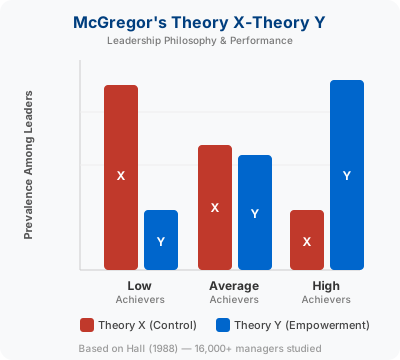
Explore how beliefs and assumptions about people shape leadership behavior, grounded in McGregor's Theory X/Y.
→
Communication & Relations
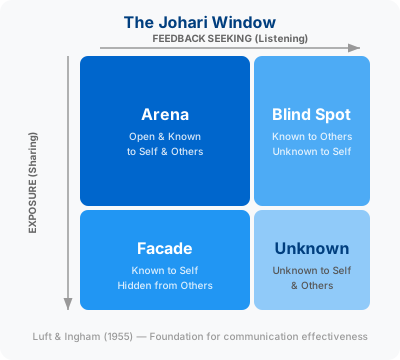
Build psychological safety and interpersonal effectiveness through openness, listening, and feedback.
→
Employee Involvement
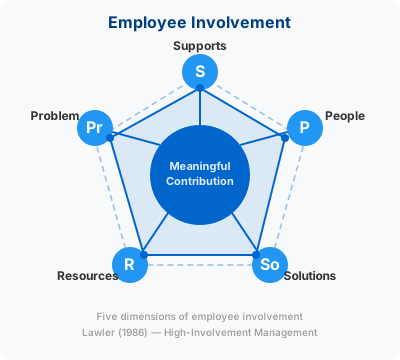
Create conditions where employees contribute meaningfully through access to information, resources, and decisions.
→
Motivation & Development
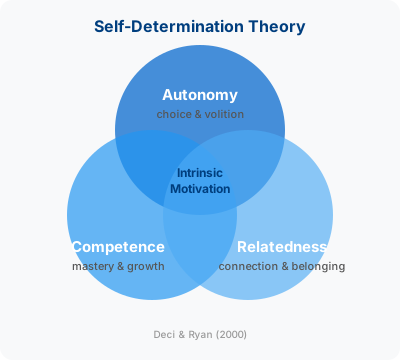
Apply Self-Determination Theory to foster autonomy, competence, and relatedness in your team.
→
Empowerment & Delegation
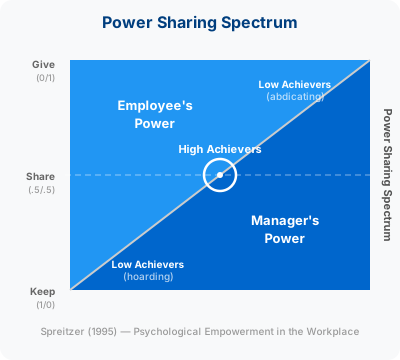
Share power effectively through decision authority, support systems, and clear accountability.
→
Adaptive Leadership
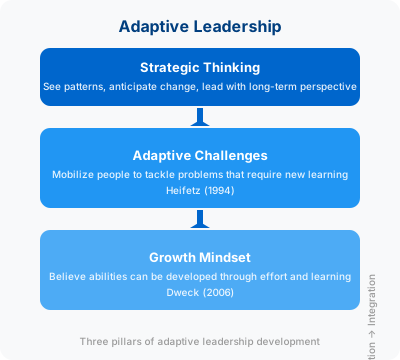
Develop growth mindset, navigate adaptive challenges, and think strategically in complex environments.
→Explore More Services
Recruiting & Hiring
Science-based hiring process to identify and select top talent.
→Strategic Planning
Proven methodologies to create a clear direction for your organization.
→Executive Coaching
Professional coaching that drives breakthrough performance for leaders and teams.
→Talent Management
Succession planning, performance management, and organizational development.
→