
New — from TeamLMI
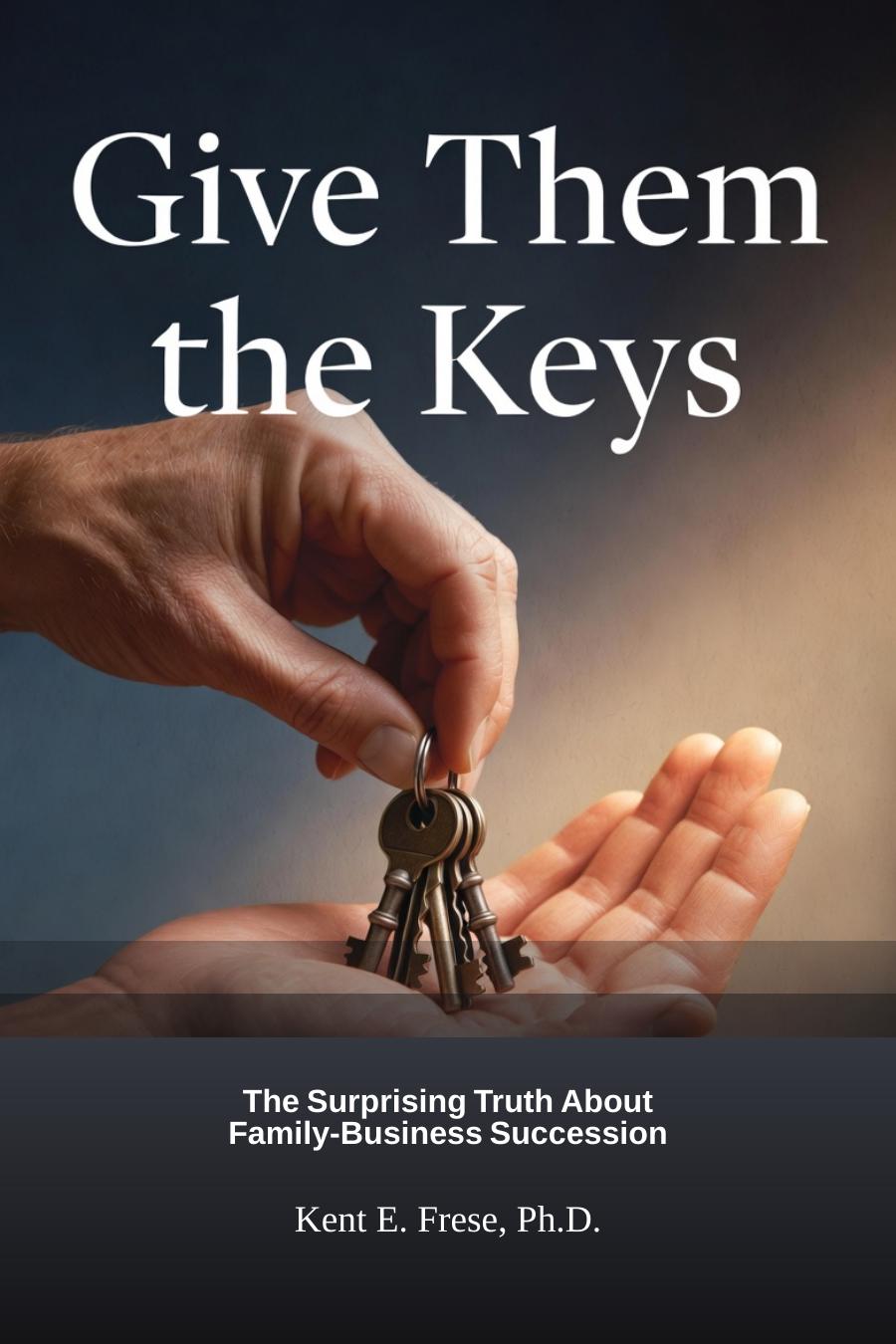
Give Them the Keys
What Families Who Actually Hand the Business to the Next Generation Do Differently
By Kent E. Frese, Ph.D.
Get the book on Amazon Talk to us about succession Take the free Readiness Checklist
Available now in Kindle and paperback.
Most family businesses don’t fail in the market. They fail at the handoff.
Every owner hears the same advice: succession is a planning problem. Start early, build the detailed plan, develop your successor on a track, bring in the experts. It sounds right. It sells a lot of consulting. And it’s not what the families who actually pull it off did.
Kent Frese went looking for the exceptions — three second-generation companies that genuinely handed over both ownership and control, and lived to call it a success. He sat down with the sixteen people who were there: founders, successors, spouses, and the long-tenured employees who watched it happen. What they shared wasn’t a plan. It was a set of conditions — five of them — that made a clean handoff possible.
Give Them the Keys is the short, honest, research-grounded result — written for both the owner who has to step back and the successor who has to take the wheel.
Read a sample — the first chapter
Chapter 1 — The Succession Trap
"Give them the keys to the place and head for Florida. That's how we did it."
An Easter dinner
The books sat on the dining-room table where the ham had been.
For years, Rob had been trying to get one of his four children interested in taking over the company he had built. He had founded Ironwood Metal Stamping in the early 1970s out of a small industrial building along a regional highway, staking his own savings to do the precision die work he had spent sixteen years mastering. By the time of that Easter dinner he was in his sixties, the business was doing several million dollars a year, and he was tired of waiting for someone to raise a hand.
So he brought the company's financial statements home, set them down on the table after the meal, and laid out the terms in front of the whole family.
"I take the books back, I'm going to see a guy at the end of the week about selling. If you want it, it's yours. If you don't want it, I'll sell it."
That was the plan. The entire succession plan. An ultimatum over dessert.
What followed was not a five-year roadmap or a binder from a consulting firm. It was a slow, sometimes awkward, often improvised process that ran for years — and at the center of it was a single conversation that, by the successor's own account, took about sixty seconds.
By then Rob's eldest son, Rex, had been working in the business for two years with the vague title of "facilitator," quietly learning every department. On the thirtieth of October, 1999, Rob called him into the conference room.
"October 30, 1999, my dad said … 'I'd like you to be the President of the company now.' … That was it. … My verification: 'That means I get last say?' He was like, 'Yup, that's what being the guy is.' That was it. Done."
One minute. No ceremony, no transition committee, no phased authority matrix. The founder told his son he was now the president, the son confirmed that "the guy" meant the guy, and they both went back to work.
If you have ever read anything about family-business succession, your instinct right now is probably to wince. This is not how it's supposed to go. And yet Ironwood Metal Stamping is still running today, still in the family, having made the leap that most family businesses never do.
That is the puzzle at the heart of this book.
What you've been told
Walk into any conversation about family-business succession and you'll hear the same advice: start years in advance, build a detailed written plan with milestones, develop your successor along a defined path, make them prove themselves somewhere else first, bring in the experts — and never leave it to chance.
There's nothing crazy about it. Faced with the grim odds everyone quotes, reaching for a plan is the natural response. It's a comforting story. It fits how we like to solve hard problems. And it sells a lot of consulting.
The trouble is that it doesn't describe what actually happened in the companies that succeeded.
Three companies that didn't follow the script
A few years ago I went looking for family businesses that had genuinely pulled it off — companies that had transferred both ownership and real control from the founding generation to the second, where the people who lived through it would call the transition a success, and where the business was still standing. I found three of them, sat down with sixteen people across the three companies — founders, their spouses, the successors, the successors' spouses, and the long-tenured employees who watched the whole thing happen — and asked them to tell me, in their own words, how it went.
I expected to find careful planning. I expected that these survivors, these exceptions to the dismal statistics, would be the ones who did the homework everyone recommends. I expected binders.
There were no binders.
What I found instead was almost the opposite of the official advice. None of the three families had a formal succession plan. None of them had developed their successor along a defined path. None of them could point to a timeline. When I asked about their planning process, several of them looked at me as if I'd asked what brand of magic they used. One founder's wife summed up the whole transition this way:
"I don't know what else to say. We just kind of fell into it and marched along with it all."
And yet these were not lucky accidents. The three transitions, for all their improvisation, shared a striking set of common features — five of them — that showed up again and again, across three very different businesses, three very different families, and three very different sets of personalities. The families didn't have a recipe. But they did, without ever naming them, satisfy a set of conditions. And those conditions are what this book is about.
Before we get to them, you should meet the families. You're going to be spending the whole book with them, so let me introduce you the way I came to know them.
The Kellers — Ironwood Metal Stamping
You've already met Rob. He is the self-taught die man who started Ironwood along that highway and ran it, with a strong hand and a strong opinion, for decades. He was not a warm or effusive boss — his son Rex once counted up the compliments he'd received from his father over an entire lifetime and arrived at three — but he was a man of his word and a relentless craftsman. He talked about the dies he designed the way an artist talks about paintings.
"When you're done you do one of two things. You hang it on the wall or you give it away. … You design a progressive die; you fall in love with it. … That's a compliment — somebody else wants it."
That line turns out to matter, because when the time came, Rob was able to do with his company the thing he could do with his dies: finish it, love it, and give it away.
His successor, Rex, was the eldest of four children and, by temperament, a businessman. Before joining Ironwood he had spent thirteen years running his own metal-finishing company, where he'd taken a failing operation and grown its monthly sales sixfold. He did not arrive needing to learn whether he could run something. He arrived knowing he could.
What's easy to miss in the tidy version of the story is that Rex was not the only successor. His sister, Paula, had joined the company years earlier in sales and marketing, and as you'll see, it was Paula — not Rob — who quietly engineered the whole handover. Ironwood is, in part, a story about siblings: about one sibling who knew she didn't want the top job, and made sure the right one got it.
The signature image of the Keller transition is that one-minute conversation in the conference room. But the line that captures Rob's whole philosophy came when I asked what advice he'd give another founder staring down retirement:
"Give them the keys to the place and head for Florida. That's how we did it."
He meant it literally.
The Mareks — Hartline Plating & Machining
Tim built Hartline the hard way. He had spent eighteen years as a supervisor at a large steel operation before walking away in the early 1970s to turn parts on a lathe in his own basement. Pushed by a vendor who let him down, he taught himself chrome plating, and over the next two decades that basement shop became a company of more than a hundred and fifty people across multiple buildings.
Tim is conservative by nature, a man who survived the brutal interest rates of the early 1980s by paying his employees before he paid himself. His wife, Jane — a nurse by training who became the company's de facto chief financial officer, running the books, the payroll, and every environmental permit — is the quiet center of gravity in the family. More than one person told me, without prompting, that she was the real backbone of the business.
The successor, Greg, was Tim's only child, and he is the spiritual opposite of his cautious father. Where Tim built carefully, Greg built relentlessly. He didn't so much take over his father's machine shop as out-grow it — building a chrome-plating operation alongside it that eventually dwarfed the original business.
The signature Hartline moment is not a handover at all. It's a retirement that didn't take. Tim announced at the company Christmas party that Greg would run the company, and for about four days he felt wonderful. Then the reality of an empty calendar in the dead of winter set in.
"Never retire in January. You can't hunt … the river is frozen … it's too cold. … Four days — I got up Friday morning, … put [my work clothes] on. [Jane] said, 'Where are you going?' I said, 'I'm going to work. I've had enough of this monkey business.'"
Tim came back. He never fully left. And — this is the part that matters — it didn't wreck the transition, because by then Greg was unmistakably the one in charge. That four-day retirement is the perfect emblem of the hardest thing in this whole book: an owner who has handed over the company can still find it almost unbearable to walk away from it. Tim's gift was that he learned the difference between staying in the building and staying in control. Hartline is the story of a founder who figured out he could do the first without doing the second.
The Brandts — Stonebridge Group
Stonebridge is the odd one of the three, and the most revealing. Jack didn't build a single company; he built a holding company that came to own roughly ten of them — marinas, a family entertainment center, a paving company, a chain of self-storage facilities, real estate. He had spent twenty-five years learning business from the ground up inside his father-in-law's much larger enterprise, starting, as he liked to point out, by cleaning furnaces.
When that larger family enterprise was sold, Jack used what remained to create Stonebridge — and here is the twist. He didn't create it to build an empire. He created it as a platform for his son.
"At the time all this happened, my dad was trying to get out of stuff. He wasn't trying to build a company. He was trying to help me get started."
Sit with how unusual that is. Most founders build to grow, to win, to leave a monument with their name on it. Jack built so he'd have something to hand his son — his ambition was Frank's opportunity, not his own empire. It's a reversal of the usual founder's psychology, and it explains almost everything about how cleanly he later let go.
You can't cling to a thing you built to give away.
Frank, the successor, had been an entrepreneur since high school, running a landscaping business that did a couple hundred thousand dollars a year while he played two college sports. He didn't wait to be handed anything. The whole Stonebridge story really begins with a single dinner-table conversation, when a chance to buy a marina came across Jack's desk and he wanted no part of it:
"I was sitting at dinner here one night and I told him this guy called me and wants to sell a marina. I told him I have no interest in a marina. He said, 'Daddy, that's my dream to someday own a marina. Why don't you talk to the guy?' That's where it started."
And then there's Frank's wife, Katie. She describes herself as "a Jersey girl" from a family where nobody took risks — her father was a union tradesman, and a steady paycheck was the whole point. When Frank wanted to sign their name to a deal that could have sunk them, the fear was hers to carry as much as his. Her account of saying yes anyway is one of the most honest in the study. It's also a reminder: succession is rarely a two-person act. There's usually a spouse in the background, quietly absorbing the risk. Stonebridge, in the end, is a story about a founder who got out of the way before he was even asked — and a successor who was already driving before anyone handed him the wheel.
The thesis
Three companies. A die shop, a plating company, and a sprawling holding company. A founder who counted his compliments on one hand, a founder who couldn't survive four days of retirement, and a founder who built a business specifically so he could give it away. Different industries, different personalities, different decades.
And yet when you lay the three transitions side by side, the same five conditions appear in all of them:
- Shared values that had been modeled since childhood, creating the trust and safety the whole thing rested on.
- A founder who shifted roles — from builder, to sponsor, to a clean exit — and got out of the way.
- A mentor who was not the founder — a sibling, a mother, a trusted friend — who stepped in at the moment it counted.
- A successor who drove the transition, rather than waiting to be handed it.
- Planning as you go — a clear objective held in common, and almost everything else figured out in motion.
Notice what's not on that list: a written plan, a defined development track, a transition consultant, a timeline. The families succeeded without those things. In two of the three cases, the people involved were genuinely surprised I would even ask about them.
This is the trap in the phrase "succession planning." It tells owners that the path to a successful handover runs through a document — that if you just plan hard enough, the transition will be safe. The companies in this study suggest something different and, frankly, harder:
Succession is not a plan you execute. It is a set of conditions you create, and a successor you let drive.
Don't mistake that for permission to do nothing. Creating those conditions and then letting go is far harder than filling out a plan. It's just a different kind of hard — the relational kind, the kind you can't hand to an advisor or capture in a binder. The chapters ahead show how these families actually did it — and what it will demand of you.
How to read this book
A few honest words about what this is and isn't.
This is not a recipe. If you came looking for a twelve-step succession checklist, the very families this book studies would tell you to put it down. What I can offer you instead is a clear picture of the conditions that made their transitions work, and the responsibilities those conditions placed on each person in the story — the owner, the successor, and the mentor.
It's also not a statistical study. I looked closely at three successful companies, not three hundred. That's a deliberate trade: depth over breadth. You're going to hear these people in their own words, at length, because the texture of how they talked about their transitions turned out to be more instructive than any survey could be. Where the research has limits, I'll say so plainly.
The book is built in three movements. First, the five conditions, one chapter each — the heart of the matter. Then a model I'll call the competency zone, which ties the five conditions together into a single picture of how a successor actually develops. And finally, the practical part: the failure modes to watch for, the four commitments an owner has to make, and a chapter written directly to the next generation, because succession is a two-person act and the successor has work to do that no founder can do for them.
The families changed names and a few identifying details here to protect their privacy; everything they say is real, drawn from hours of interviews. You'll come to know them. By the end, I suspect you'll find — as I did — that the most surprising thing about these three businesses is not how differently they handled succession, but how much, underneath the surface, they had in common.
Let's start where they all started: with values.
Keep reading
You cannot out-work your own exit — but you can build the conditions that let your life’s work outlive you.
Get Give Them the Keys Talk to us about succession Take the free Readiness Checklist